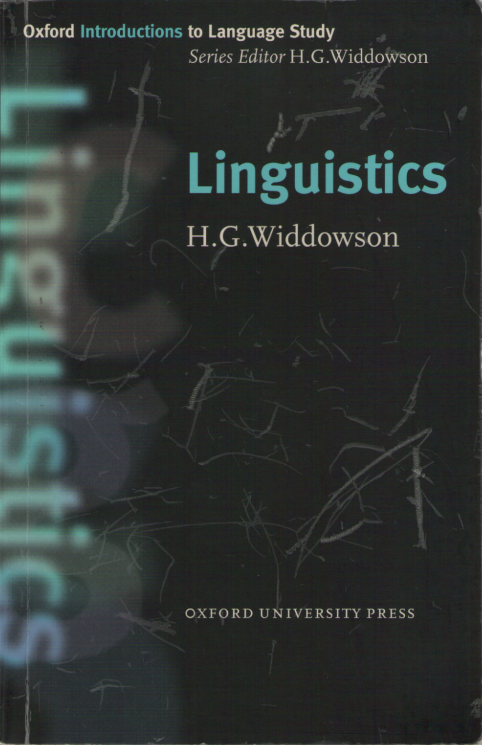
Linguistics:
Oxford Introductions to Language Study
Review
By
Mehdi Zouaoui
Information about the book
AUTHOR: H.G. Widdowson
TITLE: Linguistics
Subtitle: Oxford Introductions to Language Study.
PUBLISHER: Oxford University Press
YEAR: 1996
Pages: 134
REVIEWER: Mehdi ZOUAOUI, English Instructor, Istanbul University.
Summary
Section One: Survey
The Nature of Language
Widdowson talks in the beginning of his book about the origin of language citing what was mentioned in different philosophical and religious texts. The author begins with the biblical declaration “In the Beginning was the word”, and the Talmud “God created the world by a word, instantaneously, without toil or pains”. He then makes reference Bertrand Russell’s postulation that language is unique to humans, and that :” no matter how eloquently a dog may bark, he cannot tell you that his parents were poor but honest”. The author posits that if language is defined as “human language” and significance is assigned to particular design features accordingly, it is then bound to be species-specific, by definition
This uniqueness of language calls for some features that are only inherent to the human language such as:
Arbitrariness: the forms of linguistic signs bear no natural resemblance to their meaning.
Duality: human language operates on two levels of structure. At one level are elements which have no meaning in themselves but which combine to form units at another level which do have meaning.
Nevertheless, language innateness is not a common sense among linguists and some of them disagree with this hypothesis and even put forward the widely used argument of Washoe and Sarah as evidence of the genetic uniqueness of human language.
The Scope of Linguistics
After defining Linguistics, the author moves to the scope of this field and demarcates borders between Linguistics and asks whether its interdisciplinary with other fields is a of unilateral or bilateral nature. According to Widdowson,what is distinctive about Linguistics is that it uses the abstracting potential of language to categorize and explain language itself. In other words, abstraction involves idealization of actual data, as a part of the process of constructing models of linguistic description. Based on that, the purpose of Linguistics is then to provide models of language which reveal features that are not immediately apparent.
The idealization has some dimensions that have to be stated including spoken utterances which are repeated by the same person, though they may seem identical, are never acoustically alike in every particular instance.
Elaborating on that, according to Ferdinand De Saussure, Linguistics should concern itself with the shared social code, the abstract system, which he called langue, leaving aside the particular actualities of individual utterance, which he called parole and by that the notion of langue renders language as state not a process.
This leads us to the Competence and Performance with the former defined as the knowledge that native speakers have of their language as a system of abstract formal relations, and the latter being: their actual behavior. It is important to be aware that there are some differences between langue and competence where langue is perceived by De Saussure as socially shared, while for competence is perceived by Chomsky as genetically blueprinted.
Chomsky, one of the leading scholars of modern Linguistics, considered it as a branch of cognitive psychology and hence he adopts a formalist idealization in that it fixes on the forms of the language as evidence of these universals.
Chomsky’s ideas were not unanimously welcomed by all scholars where he defines the nature of linguistic knowledge too narrowly to mean a knowledge of grammatical form, and more specifically of syntax.
Principles and Levels of Analysis
The book then tackles principles and levels of analysis providing some key notions such as types and tokens requiring that this latter can be identified so is to recognize it as actual and particular instance of a general and abstract type.
Dimension of analysis
The author posits two variables for sound analysis which are basically:
Added to that, there are different levels of these analyses that are basically:
Graphological element
Morphological
Syntactic
Textual
Pragmatic
Areas of Enquiry: Focus on Form
The book moves then to another topic concerned with areas Linguistics, namely, the areas of enquiry of Linguistics with the first part related to the form of the language.
The patterns of sound: Phonetics and Phonology
One of the most important things is the notion of “sound” with the twists it underlie. It is important, in this regard, to highlight some notions her
e that are inherent to that area. First is Phonetics which studies allophonic manifestations, and how sounds of speech are actually made. Whereas the study of phonemes and their relations in sound systems is the business of phonology. This field also studies stress, which is a feature of speech that goes beyond the individual sound segments and operates suprasegmetally over utterances.
Construction of words: morphology
Another area of enquiry is words and what relates to them. The field that investigates this is called Morphology and here are some highlights of what this field digs at:
Derivation and inflection
Derivation has to do with the way morphemes get attached as affixes to existing lexical forms or stems in the process of word formation. As for Inflectional morphology, it does not create new words but adapts existing ones so they operate effectively in sentences. It is not a process of lexical innovation but of grammatical adaptation.
Combination of words: syntax
The other area of investigation is how words are brought together to make valid patterns. This has also to do with grammatical systems that vary from a language to another. In other words, it deals with the ways words are combined in sentences.
Areas of Enquiry: Focus on Meaning
The other area of investigation is the study of how meaning is encoded in a language, namely semantics.
The meaning of words
It is necessary here to mention that each morpheme has a semantic element and most of the times semantic an equivalent. Sometimes the distinctive meaning of the lexical host disappears and blends with the affix in the historical process of etymological change. We can also establish minimal pairs of lexical items with respect to their semantic components. This approach is known as componential analysis that provides an inventory of the semantic features encoded in lexical forms. Students of linguistics should remember that Lexical items can come as larger clusters of words and this has to be known as formulaic phrases, that is, complete units of meanings equivalent to single words.
In the same arena, what people mean by the language they use, how they actualize its meaning potential as a communicative resource is termed as pragmatics. This also brings us to the notion of reference, force, and effect.
A reference is when a constituent takes on a “pointing” or “indexical” function. Also, speech acts are widely studied in that field which are mainly concerned with relationships, not those internal to the language itself, but those between aspects of the language and aspects of the external circumstances in which it is used in a particular occasion.
Current Issues
In this part, the book takes a glance at current issues being studied and here the author reminds us at the same time that Linguistics, like language itself, is dynamic and therefore subject to change. Linguistics, the author reaffirms, should continually question established ideas and quest for new insights.
The scope of linguistics
The rationale behind the idealization of language to abstract is for practical feasibility and theoretical validity and this is what urged Chomsky to come up with competence-performance dichotomy. In other words, this is the formalist approach that was criticized by the functionalist approach that came as an antagonist of the formalist approach. Functionalist approach posits that the formalist approach diminishes the study of language to abstract forms eliminating many significant elements.
By that, functional linguistics is about how language code has developed in response to the uses to which it is put. More specifically, it is the study how the formal properties of the language informed the functions it serves, how it encodes perceptions of reality, way of thinking, cultural values, and so on.
The Data of Linguistics
One of the most vital components for Linguistics the book touched on is the source of data in Linguistics that are divided into three types:
It is important to notice that in introspection and elicitation the data are abstract knowledge and not actual behavior. Depending on the kind of evidence being under investigation, the type of data can be selected. If the internal relationship between language and the mind is being investigated, intuition and elicitation are preferred. If the evidence is related to external links with society, then the observed data of actual occurrence is preferred.
The second section offered varied readings related to the previous chapter of various school thoughts and opinions of Linguistics scholars. This was done by means of providing two different opinions, then a series of follow-up questions are added to trigger thinking outside the box of the book.
Evaluation
The book of “Linguistics” is written by H.D. Widdowson (B.1935), one of the pioneer scholars in language teaching and learning methodologies. His main field is applied linguistics and what relates to it. The book is mainly designed for people who don’t have previous knowledge of linguistics and those who want to know what this field is about. The book is divided into sections that are meant to be kickstarters for people who are not familiar with the field of Linguistics. With this target audience, the author has achieved great deal of his objectives by conveying the meaning of linguistics to the laymen and its probable applications in other related fields such as computational linguistics, sociology, etc. Having said that, the book may not be as useful as it is expected for those who have already benefited from an introductory course in linguistics even though the book has some gems scattered around and may serve as a reminder for Linguistics majors. In addition to that, the book mentioned some elements that may not serve the purpose of presenting and representing linguistics to those who don’t know it such as mentioning the different opinions about the formalist approach, represented by Noam Chomsky and the functionalist approach represented by Halliday. It is certain that Professor Widdowson has spent years in the field of language and linguistics and maybe he saw a need to promote that field, perceived by some, if not many, as a dismal science that it says more than it can actually do or contribute to the scientific community. The author of the book may be considered to have a vocation that disapproves the Chomskyan model of language through the antitheses he has presented throughout the book especially in the section of special issues. The book offers few questions to be answered or investigated by the linguistic community and rather highlights some never agreed upon issues such as the innateness of language and so on. This may rhyme with the purpose and the target audience addressed.
About the reviewer
Mehdi is an English instructor and education consultant with insightful knowledge of alternative teaching methods combining both policy and hands-on experience of the field. He has been advising and delivering key knowledge in several fields related to higher education in the Arab world such as cooperation for curriculum building between Turkish and Palestinian universities, design of study tour for officials of Saudi Arabia and Morocco on Turkey higher education best practices. He considers his formal education expertise very much complementary with his insights in non-formal education and alternative learning methods. He is a Google Certified Educator Level 1 and member of some journals.
Mehdi holds a bachelor’s degree in Teaching English as a Foreign Language from the University of Hassiba Ben Bouali, Chlef (Algeria). He is currently residing in Istanbul/Turkey.